Latest Posts

Antidote for Worry? Soup!
My worries have worries. So I built little matchstick houses

with large ceilings, a garden for them to grow tomatoes, cilantro, & carrots

their worry babies will eat.

—Laura Villareal, Poetry Unbound

Last week my friend Jenni sent me this snippet of a poem. And there it was, in one perfect image. Everything I’ve been hearing from friends and strangers alike for the last five years. “Worry babies” seem to be invading the planet: growing in gardens, dropping from trees. Once they get established, worries, like crabgrass, tend to take over, setting up residency in our brains and getting busy raising their own worry families. Sometimes they take cover in dreams, full of spikes and hooks that keep drawing us in when we’re just minding our own business. This is the work of the Nightime Worry Family, whose patchwork ticky-tacky housing development parties get wild about 3:00 am.

One of my favorite thoughts about worry comes from Bridge of Spies. Tom Hanks’ character, who is trying to save a spy who might well be executed at any moment, repeats his one question three times: “Aren’t you worried?” The reply is always the same:  “Would it help?” If you’d like to check it out this link.

Lately I’ve been asking Wilma, my inner Worry Wart, if she’s trying to help,  because it sure seems the opposite. She made the case that ignoring her completely might mean turning off flashing yellow lights that keep me safe. But often, especially in the middle of the night, her honest answer is “no.”

Although an actual worry may contain the seed of a solvable problem (or at least an action item) by the light of day, the ones that set up housekeeping and wake you up at night do NOT offer solutions. Their job is to feed on any anxieties the body may have stored. In unprotected moments, when you forget to ask if it helps to worry, they can have their way with you, repeating past regrets or imagining fearful futures in an endless loop.

The best hope for evading the Nighttime Worries is to notice the quick moment when we start to feel ourselves getting hooked at other times in our daily lives. This can be especially challenging during the holidays because that’s when worry families thrive.

Try it out for yourself. sometime, in one of those elusive moments a when a worry first arises. Ask yourself whether it’s helpful. Breathe deeply once or twice. Just this much might be enough. Sometimes simply remembering to pay attention at that moment can calm the system. Next, find a quick way to tend to your actual body in some way, even if that means washing your hands or stretching for a couple minutes. Embrace whatever acts of self-care you can, even if it means a quick bathroom Time Out in a moment of overwhelm.

When the time is right, you might ask your version of Wilma the Worrier to help develop a long-term plan. Allow some time to listen to what calms her, especially if you tend toward worry loops. Ask her to prioritize your to-do list, quietly eliminating her crazier ideas. If you listen closely, she might suggest you cut out unnecessary duties or dance or take a walk move excess energy. Or perhaps she’d like a little Time Out for herself. Send her to the spa and then give your body and spirit a few minutes (or hours) for a nervous system reset. Cozy up. Take a quick nap if you can. Simply stare out the window while savoring a comforting hot drink.

Even better, nurture yourself by getting soupy.

Warmly,

PS. Below is a great soup created from a couple of other recipes by way of my friend Martha. The first is from relishmag.com for African Peanut Stew. The second  is from  http://wpr.org/zorba/recipes/z07-0203r.htm (African Peanut Soup). Enjoy!


Getting Soupy

I get all soupy in the fall

Squash and pumpkin soupy

Mulligatawney soupy 

Chicken noodle soupy

Muertos with salty tears soupy

Sacred soupy

with your face 

in every spoonful,

each memory of you, 

all that and more

reduced now to a rich melange

congealed on the serving spoon

at the end of this meal.

But I’m still the same greedy monkey

who sops it up, every bit,

with a soft sourdough roll.

—SgB

November, 2022

Martha’s Peanut Soup w/Veggies 

1 tbsp. olive oil

1 onion finely chopped (about 1 ½ cups)

1 medium bell pepper (chopped)

1 large yam (peeled and diced)

1/2 chopped carrot (2 small)

1/2 cup chopped celery

1 cup zucchini, diced

3 cloves garlic (more to taste)

2 tablespoons minced, fresh peeled ginger, more to taste

Jalapeno pepper to taste

*1 tablespoon curry powder 

(or this combination of spices: 1 tsp. ea. mustard seed,

ground cumin,. turmeric, coriander, cinnamon plus ¼ tsp. cayenne

1 (14 ½ oz.) can diced tomatoes, drained (or may use combo. of diced toms. and salsa)

4 – 8 cups veggie or chicken broth to desired thickness

1 bay leaf

1 ½ cups edamame

1 cup garbanzo beans 

¼ cup creamy or crunchy natural peanut butter or almond butter (mix in bowl with some of the broth)

¼ cup chopped fresh cilantro

5 oz. baby spinach or kale, torn into bite-size pieces

Salt and pepper to taste

Brown rice

1) Heat olive oil in a large saucepan, add fresh veggies (zucchini last), sauté until soft and translucent.

2) Add garlic, ginger and curry spices and sauté until fragrant.  Add tomatoes and bay leaf, cook uncovered until tomatoes are slightly reduced.

3) Add broth, diluted peanut butter, edamame and garbanzo beans and bring to a boil.  Reduce heat to low and simmer.  Cook until thoroughly heated.  Stir in cilantro and spinach until spinach wilts.  Season with salt and pepper.  May  top with fresh cilantro, diced green onion and/or plain yoghurt.  Serve over rice.  Serves  8.

Balancing in the Land of Autumn

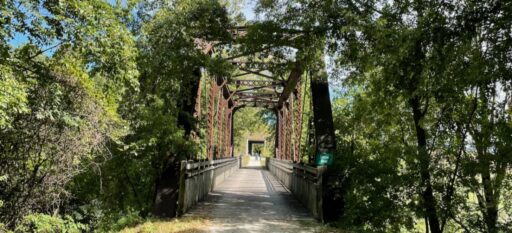
Fall Equinox found me in in Augusta, Missouri. a town of two or three hundred in my home state. I was there for a biking adventure covering a chunk of the Katy Trail, an official state park that winds through farm and river country along the Missouri River for 253 miles. Now the longest Rails to Trails route in the country, the land was first cleared by the MKT railway (This stands for the Missouri, Kansas, and Texas, or the Katy line, for short). 

The Katy Trail is the longest uninterrupted biking and hiking path in the country represents the collaboration of industry (railroads retiring old lines) and donations, with a whole lot of negotiations along the way. 

In the 1990’s, when the trail was being developed, the folks from the tiny farm towns along the Missouri river were not happy. They feared invasion by outsiders from other parts who would no doubt bring drugs and other undesirables into their insular communities. In other words, Trouble in River City.

The path turned twenty last year. And the struggling farm towns along the way are  now dotted with profitable B & B’s, antique stores, and restaurants.

The first wine country in the US has been reclaimed. The path winds through an area that once produced more wine than anyone else in the country, but during prohibition all the established old-world vines were ripped out of the ground.

So it’s possible that the path has brought danger to the river cities, but whatever danger that is, it probably wouldn’t start with pool halls. These changes have defied expectations and provided triage for the shrinking small-farm economy. 

So what does all this have to do with Fall Equinox?

When I woke up on September 22 in a beautifully restored Victorian B&B in tiny Augusta, it made sense. For me this time of year is all about balance, especially the balance of opposites, just as light and dark are equal on this one day of the year. So it seemed a fine way to spend the day, balancing on my bike, speeding along the flanks of the Missouri River, thinking about the unity of opposites. While breathing in the serenity and idyllic beauty of limestone cliffs and spacious river and autumn colors.

But my mind kept returning to opposites in politics. In the middle of vacation. I know.

For me the political and regional divisiveness of the last few years has been exhausting. I glean the news to find a sense of hope, trying to create equilibrium in my own mind.

But on that first day of fall, in a town once abandoned as river commerce died, it occurred to me that I was in the right place for the season. In the exact middle of America, in the middle of a “red state,” riding on the shoulders of the widest river in the country (and third widest in the world), all felt in balance.

This, I thought, is truly the middle path. Not conservative or liberal, not afraid or angry. Just people meeting people, people helping people, people connecting with people, acting from kindness and generosity, with a little free market enterprise thrown in. From that middle way has come a gradual trust, a balanced change. An inspiration for my own life, certainly. And a blueprint for our country and our world. A hope for a future of small, local action. A path of equilibrium.

Katy the Trail

You pierce the heart of this continent

like a dogwood arrow slowly landing 

under green canopy, in a bending and twirling pas de deux with the third widest river in the world. 

Who needs the Amazon or Congo

when there’s the Missouri River, queen to her core, 

lined with wrecked steamboats,

bare muddy shoulders cloaked with horsetail reeds

scattered bouquets of purple asters 

fields of radiant yellow blooms with black eyes?

Katy, without the clickety clack

of iron horses 

Your job is to be, 

still and quiet, 

offering your charms to human pedalers, 

sharing your warm embrace equally 

with copperheads and bicycles 

and sworn enemies of red and blue, 

giving a hand up to farming hamlets

no longer ghosts of the past 

but offerings to a future of beauty and simple pleasures, 

seated in the power of place.


—SgB

October, 2022


The Magic of the Crack Between Worlds

Here in the Northwest, reliable sunny summer weather typically lasts for only a few weeks. Summer can feel like a crack in time between seasons. So many of us try to wring out every little drop of out-of-door essence, condense it, and bring it home as a hedge against winter (or other unforeseen quarantines). 

After our family’s mountain cabin burned down in the conflagration of 2020, after hanging out for a couple of years in pandemic isolation, my long-time husband and I decided earlier this summer that it was a good time to drive down memory lane. So we headed out, bikes in tow, to visit outposts from our early lives, when we were in our early twenties and worked for the forest service on recreation and fire crews, usually in remote locations. It felt like peeking back through a crack in time. Fifty years of time.

Our trip began with the lookout tower where we resided and kept fire watch in our early twenties, George was designated main lookout, but he was also a fire fighter. When there was a lightning bust, he’d put on his hardhat and drive a fire tanker down the hill to try to find spot fires. Then it was my turn in the tower to track the lightning hits, using binoculars to detect an orange glow, trusting an amazing device called an azimuth finder to align it with his headlights. This all had to happen while standing on a glass stool, careful not to touch metal so as not to get fried by lightning.In other words, boredom bookended with occasional hits of adrenaline. 

We lived in our workspace, so we spent 24 hours a day in the same room for six months. Edward Abbey, an acclaimed environmental writer who lived and wrote in a lookout tower for three years, said that the best test of a marriage was to assign a husband and wife a job on a lookout. According to him, “Couples who survived this were destined for a long marriage, and they deserve it.” In my humble experience, it also helps if you’re young or in that “merge” stage of love that makes small spaces cozy and desirable. Lots of things have changed in our marriage during that gap of time, including our relationship with personal space, but we seem to still be living examples of Abbey’s contention.

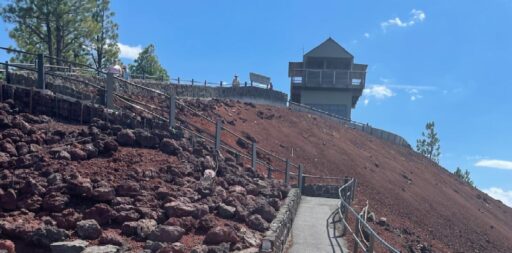
One lookout where we lived was at the top of a steep road that wound its way up a cinder cone. The entire range of the central Oregon Cascades was our wallpaper. At night the stars and flirtatious visits by the Northern Lights were our entertainment. The tower stood out as a sentinel on the caldera, and it was also the first structure of an area that is now a national monument. So our little cabin on stilts served as an interface between the wild world and humans. We were only one flight up some stairs, so during the day the same refrain drifted through our windows: the sound of winded tourists would gasp for breath while they read the altitude sign. At high volume. And the altitude never once changed in all that time.

Most of the time we laughed at life there on the crack between humans and the wildness of nature. We hung out, staring out over the land for a blue haze, binoculars at the ready. While one or the other of us did that responsible thing, the other read or played an instrument. I planned to learn to play the banjo and never progressed past “poorly.” But we worked up a fake-bluegrass version of Smokey the Bear to torture the visitors at the end of the season. We got back at those altitude readers. I marvel now at our ingenuity and ability to entertain ourselves.

We were the last people to live in this particular tower, which is now staffed only during the day. It was a bit of a shock during our first stop on this summer’s nostalgia tour, then, when were boarded on a shuttle bus stuffed with other tourists that disgorged passengers about every half hour at the top of the caldera. I gasped my way to the top of the crater, stopping to read the altitude sign. Out loud. Once there, it almost seemed as if we were able to enter a crack in changeless time because it was all so familiar. Except the number of people swarming the caldera. I was taken aback by how rugged the living was, with a far steeper hike than I remembered, especially round trip down the little switchbacks to the only bathroom, a pit toilet.

We continued our trip to a couple of once-isolated resorts, now full of people, even though the pristine areas remain protected and once again seemed much the same, and there was an odd sense of comfort consistency in nature. We biked through stunning meadows and looped a whole lake, grateful for new bike baths. Another day we pedaled through the remains of whole towns that burned down and are now being replaced with manufactured villages, stripped of gardens and trees. Blackened ghost trees hovered dark and tall over new growth of grasses and ferns along the creeks, witnesses to the cracks in the world created by wildfire.

Ever since that trip, I notice that little cracks of wonder are everywhere, in so many places: old times and now times, honeymooners and silver anniversary celebraters, wild spaces and civilized ones, children and grandparents, night and day, destruction, damage, and renewal, summer and fall, There’s a magic in this simple but profound peek between worlds. A sense of being held by all of it, despite occasional evidence to the contrary. 

May you find yourself held when the cracks in your world don’t seem kind.


Long View

Over fifty years ago 

we went to sleep every night 

in a glass house tied on top of poles 

perched on a lava cone.

Our enemy was a flash of lightning, 

a pewter puff in the distance 

a glimmer in the dark 

a smudge in a valley.

Our tools were a radio, 

a behemoth metal fire finder

and a platoon ready to pounce.


We woke up embraced by mountains, 

watched the snow dissolve until it was gone,

went to bed to among stars and sometimes

the green petticoat of northern lights flounced our way.


Our fears then were lightning busts,

renegade campfires

and the thought that

we might end up living ordinary lives.

First one and then the other of us 

was the on-duty watcher 

while the other one was left 

to dream and scheme.

And right there on the caldera we began

to gradually glimpse our future 

circled by an entire range of mountains,

and all the time in the world. 


And when autumn came and socked us in

we surrendered, unready as we were, and 

began to grope our way 

into what was next.


—SgB

August, 2022

Subversive Power of the Smile
Happy Summer!
 
Gathering in community is challenging right now, for oh so many reasons. We’re already reeling from culture wars fed by deeply-held beliefs and trumped-up divisions and differences. Then there’s the confusion and chaos of rapid change. To make it worse, recovering from the isolation or trauma of the pandemic sometimes makes it awkward to simply be around other people. At long last our mouths are mostly disrobed. But I notice even this can be awkward, even for me, a naturally friendly person in a small, relatively safe town. For those who are just beginning to emerge from grief, anger, or fear from the troubles of the last couple of years, it can feel frighteningly vulnerable.
 
As human beings, it is our nature to thrive when we gather with others. So how do we go about life now, in our first “normal” summer in three years? Some of us start with church or go to farmer’s markets. Others brave the unpredictability of airline travel flights to reunite with family and friends. Or we find ways to naturally embrace real live community, in public spaces with children playing and babies toddling, perhaps accompanied by actual live music.
 
Lately I’ve been thinking often of a long-ago trip to Thailand, “Land of Smiles.” Even though the airline lost our bags, even through jet lag in a country radically different than my own, I experienced a curious feeling of well-being after a couple of days. I had already noticed that all the locals smiled as we passed. All of them. It was infectious and also faintly familiar, like going to the Oregon Country Fair or another festive gathering. But it took me a while to figure out that so much smiling had some powerful juju.
 
What I now know is that in Thailand there are 13 or more distinct smiles. The most common, reserved for strangers, is a smile to say hello, a polite courtesy. But even this smile, which I might usually find insincere, had worked on me. Since that trip I’ve discovered research on the increase in dopamine and endorphins and all manner of good chemicals humans experience when smiling. And yes, studies show it’s infectious to give and receive smiles.
 
I recently thought about the Thai tradition of smiling when I read these words by Richard Rohrer: “We don’t think ourselves into a new way of being. We live ourselves into a new way of thinking.” I suddenly knew just how to go about recovering from my awkwardness. I could live myself into a new way of thinking by the simple, conscious practice of smiling at folks whenever or wherever I could, regardless of what team they seemed to be playing on.
 
My radically subversive act began. Almost immediately what might have seemed false before felt like my true nature. I was living myself into a new way of thinking by simply smiling.
 
It’s been a remarkable experiment. Infectious. Fun. And real.
Join me? 😄
 
True Nature
 
Yesterday down the oak outside my window
A masked raccoon slowly crept, face first, 
Striped tail straight up, prehensile claws holding fast. 
Tiny nuthatches do this too
And somehow the earth doesn’t rise up 
To claim their bodies, break their necks,
Or punish them for their arrogance.
Must be their true nature, I think.
 
Meanwhile, this body of mine, 
held upright by bumpy ankles of many breaks,
Plops and slides down the slippery clay riverbank 
butt first rather than risking a crooked footfall. 
Sometimes, I think, true nature 
also requires getting low on the earth,
having a seat, and then trusting gravity with the rest.
 
 
—SgB 6/2022

Me Too, and Us Together

The courage to tell the truth and then to live it is at the beating heart of my understanding of feminism. I can still clearly recall the precise moment that this knowledge was born.

I was a newly married 21-year-old who had moved from the Midwest of the early sixties, through a time warp and straight to the hive of the counter culture that was Eugene, Oregon in 1969. The university town was becoming a growing refuge for a motley collection of hippies and yippies and draft-dodgers. Many of them had fled north to get away from the dark aftermath of Haight-Ashbury’s famous Summer of Love.

I, on the other hand, was just fleeing my sorority in the Midwest.

On our first day in Oregon my brand-new husband George and I were unpacking our wedding gifts and settling into our first apartment when a scruffy-looking guy came up the stairs to introduce himself. …and to check me out. Somehow I was surprised because I had thought that marriage was going to change all that, to keep me in a safe bubble. A couple of days later he showed up at my door when I was alone. But George happened to show up about that time, and my “admirer” did a quick about-face.

About a month later, Vanessa, one of my new friends, was raped as she was walking alone on campus at night by someone who jumped out of the bushes at her. Within the next week the same thing happened to two more female students. Vanessa was already a timid and shy person, but now she was even more quiet and withdrawn. Our small group of graduate students made sure she never walked alone. One evening while I was walking her home from dinner, I stopped to say hello to my downstairs neighbor and “admirer.” My friend kind of shrunk, becoming almost invisible. When we got home, she said that “that guy” seemed eerily familiar, that he might even be the perpetrator. She agreed to go to the police. We were there for several hours. They took polite notes but said they couldn’t go further “because the other two victims had already left for Christmas and couldn’t be interviewed.” We never heard anything back.  As far as I know, the case went unsolved.

This is one of my many “me too” stories, but it’s also a kind of “her too” story. Or an “us too” story, as I soon discovered.

Women’s Rally for NOW, the poster said.  Something about it caught my attention, some unresolved feeling left over from my friend’s rape.  This was that new group I had vaguely heard about.  I was no “women’s libber,” a label the people around me had always used with an eye-roll. But something about the poster, on the heels of my friend’s rape, beckoned me to move straight out of my comfort zone.

I went to the rally by myself because I was pretty sure that men weren’t invited. Never before had I been in such a large group composed entirely of women, and these women were so loud. I wasn’t so sure how I felt about the word “oppression,” but when these women gave true-to-life examples of women’s victimization, I just knew these things. Then some of them started talking about men as “chauvinist pigs.” But there was a funny feeling in my body, like something was popping. It was a bodily sensation that started in the bones and seemed like truth. Each time a new example of the social injustice of being a women was described, I felt the same feeling.

A flush of realization took over. What I saw in bold relief, was the oppression in my own mind.  I could see so clearly how I had shrunk to fit the people around me my whole life. And there were other ways I tripped over myself, too. And I couldn’t put it all on “them.”

It was “me,” too. Somehow I knew that THIS was also a part of what needed to change.  I knew clearly that I could do something about this, starting right then. All I knew was that the voice inside my head was strong.

I’m not a mic-grabbing kind of gal, but something was different that night. My voice shook, a reverberation that started with my knees and moved up. I was sure what I had to say wouldn’t be popular. But when someone handed me the mic, I said whatever needed to come out. I talked about my own internal obstacles, and made the commitment to starting with my life and cleaning up the ways I sabotaged me, before I started blaming the men in my life. The crowd cheered. Right on, Sister! I was stunned at their response. I had expected an argument. All I knew then was that something was happening, and I was a part of it.

I’m pretty sure I had never heard of the “personal is political” idea, which came to define the “second wave of feminism” which began that year. I’ve since learned that this move toward awareness was happening all around the country at the same time, like seed pods popping. The consciousness-raising groups that followed were “me too” groups, but we were all in the same room. Geographically limited compared to a Facebook movement, but it had its advantages.  We told our stories. We held each other’s hands. We also held each other’s feet to the fire, naming and questioning the internal obstacles to being a Strong Woman. Assertiveness groups were born.

Since that day I’ve been in more consciousness-raising groups than anyone I know. And those groups were followed by other women’s circles, book groups, spiritual growth groups, and artists’ and writers’ groups: probably twenty in the last fifty years. I created classes on women’s history and literature studies at high schools. During my 25-year career as a teacher I listened to hundreds of young women. So by now I have heard thousands of stories from women of all ages, describing the ways they have been discounted or humiliated by men.

But what I noticed is that sometimes in the telling and re-telling, people didn’t seem to move on. As they repeated their story, they seemed to rehearse a plot with themselves as victims. All the energy that could be used for real change, to create powerful lives, got lost. They were shrinking to fit.

This is a price that we can’t afford to pay at this time in history. The time is right for abuses to be named and for abusers to be exposed. As we tell our stories and stand together we stand taller. But the vital question is this. Where to go from here? Will the Force within us and among us give us the personal strength to step out, to keep going, to question and change a culture that shapes us in so many ways to lose our inner knowing and strength? Will we make this work so important that we will have the strength that we never admitted to before, starting inside ourselves and manifesting in how we show up in the world? Will we then continue to be moved to act as one, a force of survivors?

Yes. We do need to tell our “me too” stories. This is how we are becoming an “us too,” a collection of women and men who will demand respect for all. We will run for office, we will support our sisters. We will stand tall… taller… together.

And, most important, we will not shrink to fit.

Holy Drifting

For me autumn is the holiest of seasons. In the Northern Hemisphere, the days are shorter and the slanted light captures the vibrant riot of colors as the leaves drift downward. I like to drift, too, during this time-out-of-time, as the dark gradually takes over and allows more room for silence, for the coziness and candles and comfort from the growing chill. I celebrate these holy days quietly, allowing time to expand, to create enough space to observe the subtle and slower inner movements that draw me into the coming mystery of the dark time of year.

I store it all up as an antidote for the coming racket and good cheer of conventional holidays. Once the calendar moves through the passage we call Halloween, all that inner focus becomes more difficult. It can take considerable focus to keep the “holy” in the busy-ness of the Holiday Season as it expands to fullness and finally spends itself on New Year’s Eve, two months later.

I spent the last couple days in the old growth forest of the Oregon Cascades. Thankful for the opportunity to hang out with the “elders”, I drifted here and there, taking in the brilliant gold of maple leaves that slanted sun rays had lit up on the forest floor. The creek tumbled, and the cedars broadcast their perfume. I let myself be astounded by the vermillion vine maple in front of me, the cedar and pine giants around me, wondering about their long view of the short-living species of humans. Now that the fire danger of the last season had passed, my usual problem-centered brain was taken over by the rhythm of the hike, the gentle musing mode of the unfettered mind.

For a couple of days, I gave up the problem solving mindset, making room for a satisfying substitute, long rambling walks. I immersed myself in The Hidden Life of Trees, a book with enough scientific information to open me wide to the magical ways of the forest and to the perspective of time that two- and three-hundred-year-old trees might offer, as I slowed down and listened. The forest became a wonderland of subterranean mycelium with their slowed-down synapses and immense towering giants, holding court as they absorb the sun’s rays.

When I returned to the cabin from one of my rambles, I sat down to tea by the fire and opened a new book called Devotions, a sweet collection of Mary Oliver’s poems, selected by the author. Immediately, the poem “Drifting” jumped off the page. It’s wonderful to walk along like that, not the usual intention to reach an answer but merely drifting. Once again, one of my favorite poets has captured a moment, a day, a life in just a few words.

Drifting, by Mary Oliver

I was enjoying everything: the rain, the path
wherever it was taking me, the earth roots
beginning to stir.
I didn’t intend to start thinking about God,
it just happened.
How God, or the gods, are invisible,
quite understandable
But holiness is visible, entirely.
It’s wonderful to walk along like that,
thought not the usual intention to reach an
answer
but merely drifting.
Like clouds that only seem weightless.
but of course are not.
Are really important.
I mean, terribly important.
Not decoration by any means.
By next week the violets will be blooming.

Anyway, this was my delicious walk in the rain.
What was it actually about?

Think about what it is that music is trying to say.
It was something like that.

Today I share this with you, as I return to a world which screams of “problems to be solved,” both personal and political. I can no more block these out than the cries of my children as babies. But whatever actions I take will be informed not just from the problem-solving mind, but from the answers that have come from the holy state of drifting and listening to the elders.

People-Watching at the Mandalay Bay (& Beyond)

A week ago yesterday I sat at the Mandalay Bay Resort in Las Vegas, immersed in my hobby of people-watching. It was the perfect, calm finale to a colorful week of nature and hiking with lifetime girlfriends in Utah’s brilliant landscape.  A couple of us had decided to soak up a few more hours of sun while waiting for our evening flights, and my friend suggested we have lunch and loiter at the resort across the way.

While we hung out, I got curious. I had no idea what brought all the fresh-faced young people there. They didn’t fit the image I’d always had of Las Vegas, which I’d only visited once before in my life.  I felt blessed by their happiness as they lined up with big inner tubes to float in the pool. I like to think I blessed them back with my eyes as I appreciated their humanity. To me this is the essence of people-watching. It’s like a blessing, a basking in the joy of sharing the planet together in a particular moment, because that’s all we have. Later Sunday I got proof of that.

As we returned to the airport after a couple hours, our Lyft driver Javier pointed to something that looked to me like a construction site.

“There’s a big country-music festival here this weekend, with big stars,” he said.

“My wife is so excited about this guy tonight with a deep voice . . . Jason somebody. She’s going to be in the front row, she says.”

I glanced back over my shoulder at a chain link fence with warning signs. It looked like your basic construction site. Apparently the venue was in a deep pit, I thought.

The next morning, in my bed in Oregon, I began to get texts checking on my safety. One of the first reports described a shooting “like fish in a barrel.” I thought back on the “construction site.” As tuned in as I like to believe I am, I’d had no warning that it could also be a “destruction site.” I wonder still about Javier’s wife.

Disbelief. Shock. And then a parade of the faces from the day before. More disbelief. Tears. A deepening grief. When I told someone about it, my refrain was, This is not about me.  My “thoughts and prayers” went into overdrive as I imagined each person I had seen there, now possibly dead or struggling for life.

Next day I saw a drawing of the shooter’s window. That was when I realized the courtyard where I had lunched was a direct shot. Twice as close as the amphitheater. Suddenly my world began to seem less predictable, less like something I would want to take for granted. There have been waves of grief, anger, and shock since then, mixed with tiny flashes of understanding. I’m guessing that insights and perspectives will continue to pop.

It’s too big, too close still for a landing place or a Tidy Take-away. I sit still in “thoughts and prayers” for the victims. I’m not done looking for the best way I can make a small difference when it comes to violence within our country and outside it. But I am committing not to forget or get so fogged in by all the stories and distractions swirling around me in the culture at large.

I truly have no idea why bad things happen. I’m just not in charge of that. But one of my life practices is to find some wiggle room in even the worst of circumstances.  It’s sometimes enormously challenging to find a slight break in layers of dark clouds. But I have lived long enough to understand that sometimes something good, some healing comes from tragedy. I put my faith in that. Because from that margin of wiggle room I am more likely to embrace my own life, to embody a loving presence in the dark face of ignorance and insanity. I’m by far more likely to take an action on behalf of wisdom and sanity. And, most important, I’m far more likely to have unclouded judgment about what that action will be.


Photo “Mandalay Bay, Las Vegas,” (c) Erin Khoo, used under CC by 2.0 license

Evacuation & Return

Six weeks ago I spent a quiet weekend at our Cascade cabin, and the first smoke of the overwhelming fire season to come caught my attention. Like the animal that I am, I began to scan my surroundings with the focus that a whiff of danger brings. Instantly I was aware of what was at stake, something I’ve taken for granted for the thirty five years that I’ve visited this old growth forest. I looked up, as if for the first time, and I silently jotted a few words in my journal.

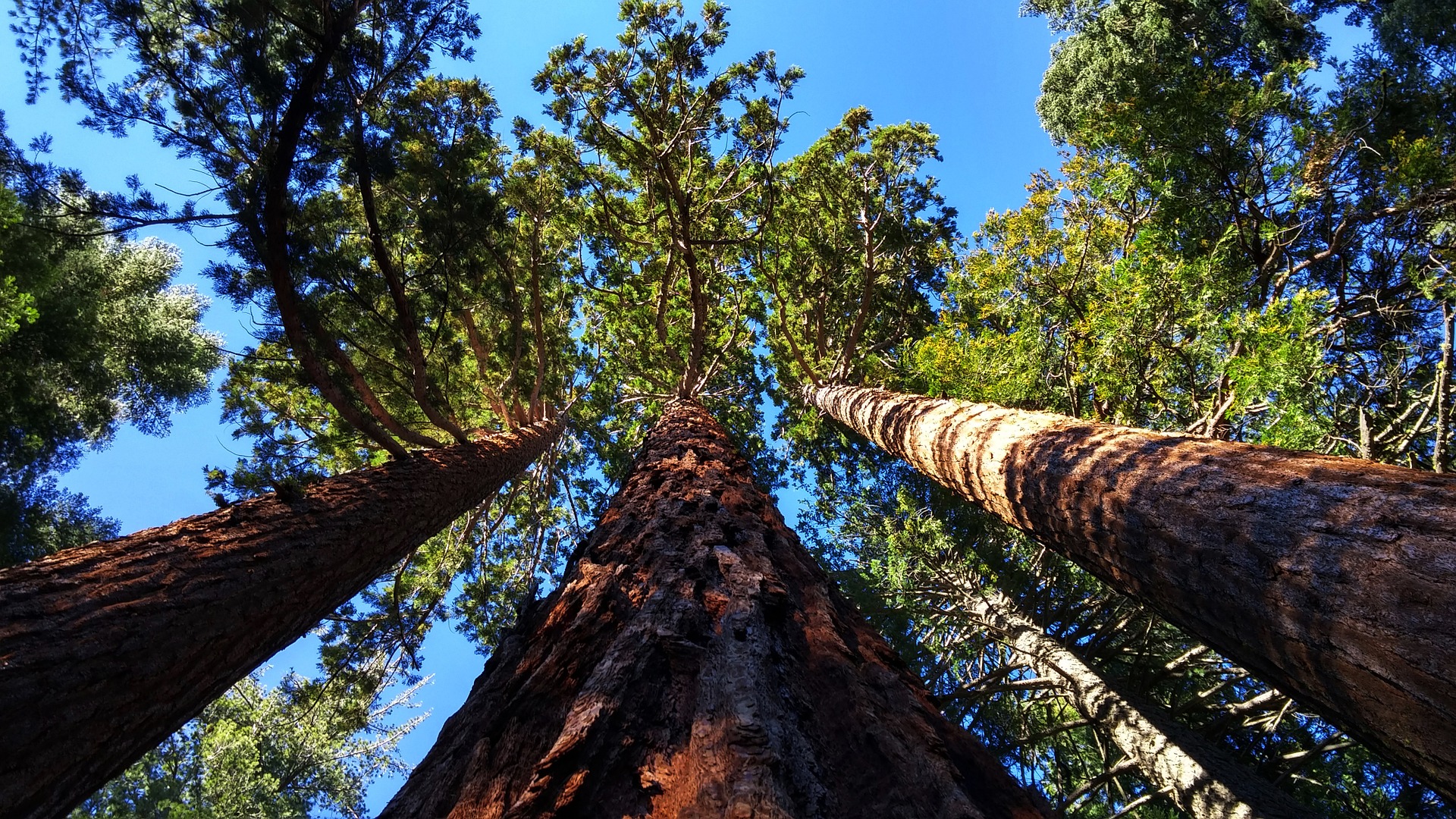
Who are these enormous beings I’ve categorically referred to as trees? I look up. Up. Up. 12 stories up are their heads. Western red cedar, grand fir, yew, mtn. hemlock, chinquapin, from babies to snag-headed old ones. They haven’t moved anywhere all this time, steady. Where have I been until this moment to have missed them?

I went home to the suburban oak savannah where I usually live. The smoke followed. I thought often of the trees in the forest around the cabin and sent a prayer. Then I came across this poem:

 Lost

Stand still. The trees ahead and bushes beside you
Are not lost. Wherever you are is called Here,
And you must treat it as a powerful stranger,
Must ask permission to know it and be known.
The forest breathes. Listen. It answers,
I have made this place around you.
If you leave it, you may come back again, saying Here.
No two trees are the same to Raven.
No two branches are the same to Wren.
If what a tree or a bush does is lost on you,
You are surely lost. Stand still. The forest knows
Where you are. You must let it find you.

— David Wagoner (1999)

The next month took a certain rhythm. Fire reports every morning. Stair-stepping through the levels of evacuation as the fire approached, less than a mile away. After a while, the cabin didn’t matter any more. I just missed the trees. I imagined them turned to charcoal.

At the end, in a neck-and-neck race between the fires and the rains, the rains came, for five straight days. Just a couple of days ago we got word we can go back. My own particular trees survived. And now, as I prepare to return, it’s to a new landscape. Even though the surrounding forest hasn’t physically changed, I have.

I re-read the poem I stand still, at home with the oak trees, seeing this grove for the first time, each individual tree. Here. They were surrounding me all along, making a place while I worried about the forest in the mountains. And when I do return to the ancient forest, I will pay attention to the breath of the forest, to the answering that says “Here.” And I will listen.

Wonder Woman Meets Wondering Woman: Summer of Wonder

I was never Diana Prince, exactly, with her random collection of skills and her athletic-yet-flirty costumes. But she was my main goddess when I studied and taught archetypal psychology during my middle-ish years, as a young, energetic woman with a mission of upholding peace and justice while raising a the next generation with an even hand, healthy nutritious food, solid values, and all other things good and true. Revisiting her in film form this summer was much more thrilling and significantly less exhausting.

Long before the concept of “online retail” was born, Amazons inhabited a room in the mind for women so committed to their own skills with bow and arrow that they wouldn’t let a breast (or two) get in the way. It was that time of life, that state of mind. I needed every bit of that sassy fighting spirit to cut through the complexities and obstacles of my life. Artemis is still a part of me, ready with her quiver and bow when I need to write a letter or make a phone call.  No matter what’s going on in the world around me, I too put my faith and energy into the power of love over hate, a story plot acted (and acted out) many times daily on the world stage.

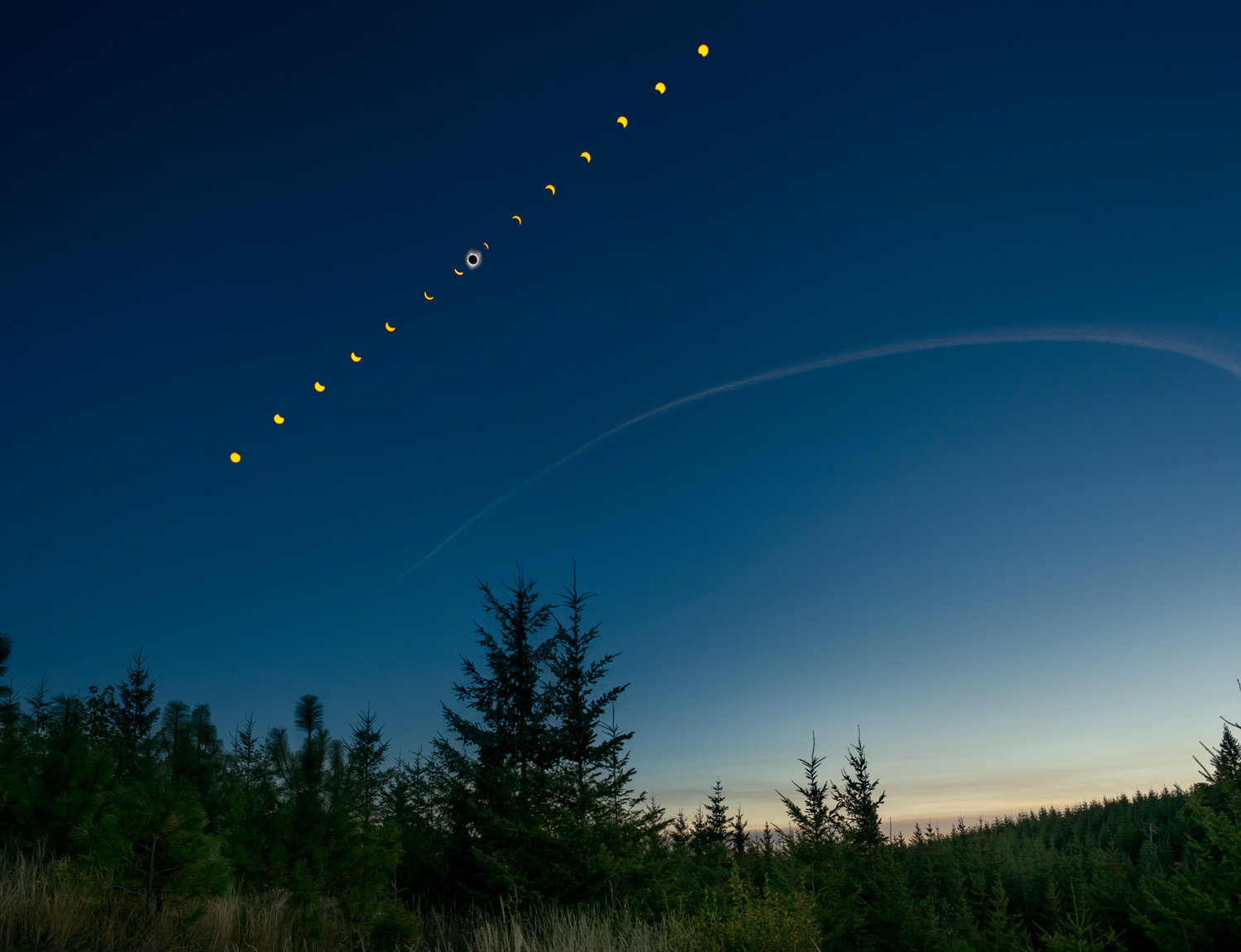
Artemis stepped up recently to plan and prepare and hunt and gather the resources before the total solar eclipse in my neighborhood. She awoke early the morning of the event, to check out the newest world situation, and to put together the food and gear for visiting friends and family. Just the way she has helped me manage life so many times before.  But then another Shero took over. I’m calling her Wondering Woman, and Her superpower is (you guessed it) a sense of wonder. Just before the day got rolling, she whispered that it was time to step back from the fray and listen.

Watching the glowing new honeylight where I have awakened to the meadow in my own little orbit of friends, family, community for the last 40 years. Dove calls across the way to listen. Knowing the sun will soon be nearly erased by the moon, I’m trying to understand what that might mean, even astronomically, but my mind can’t hold it. Anticipation in wind. Cars speeding by to find the right spot in a couple of hours now. Three. Two. One. Breath filling body, staying in the miracle of this infinity. Inside and Out. Moving deeper and deeper into wonder. They say this and that about experiencing totality. Anticipation rides the air currents. I wonder. I’m open. I’m watching.  I’m wondering.

Wondering Woman has stayed with me ever since. After the experience of “totality,” like millions of others stopped in my tracks by Something, I’m still wordless and deeply curious about the power of the concentrated absorption of so many humans, waiting together in a deep communion with the Unknown. I stand in wonder at the power of millions of us willing to be struck with awe by something infinitely bigger than our usual frame of reality. We were united by a collective openness to the irrefutably bigger picture. For a few minutes there, as the unimaginable happened and the daylight world was lit by a mere glimmering parabola, I found my tribe, the Wonderers. And we are amazing. Amazed.

And so in this time of my life I’m bowing to my new archetypal heroine, Wondering Woman. She’s a mature Pandora, this one (and I am not referring to the online music distribution site). She’s a Wise Elder-Goddess, one who holds space for the invisible, who bridges the inner and outer worlds with skillful attention and vast curiosity. She’s the Goddess of open and curious mind and heart.

Woman of Wonder. The sequel. I’m curious. Welcome to the tribe.

Photo thanks to my friend David Paul Bayles and the miracle of photography

The Path of Totality: Where Sun Meets Fire

Eclipse Fever collides with Wildfire in my environmental newsfeed this month. In only ten days, my abnormally “normal” town will become a swollen version of itself. As the planetary wheel turns, we’re one of the very first and most reliable viewing places for the total eclipse, given that the Oregon Coast has a foggy and questionable personal history. Frankly, we see it as the most charming place from which to watch, bar none. But just how charming is something we try to keep very quiet. Notice I’m not being very specific or dropping its name.

The jig is up already up, though. Most of us with empty rooms in our homes have long had them booked with long-lost family or friends. The Willamette Valley floor is sprouting campgrounds in abundance, at $200 to $750 per site. We’re stocking up as if a snowfall were imminent, aware that our town will likely double or triple or quadruple in size. We’re also tuning up bikes so we can stay on the bike paths and out of traffic snarls, the ones that we’ve we’ve been warned about since April.

This will be the second total eclipse I’ve witnessed. The first one was in 1979. As I was recently reading the mystical accounts of eclipse stalkers, I reached back to remember…very little. Popular culture seemed far less interested in things celestial back then. The path of that total eclipse was a Nike-shaped swath over Washington and up into Canada so there was almost no Eclipse Hoopla. My husband and I and baby Ben simply drove the night beforehand a couple hundred miles to the rolling hills of southern Washington and parked our VW van on a wide spot in the road. Across the gentle hills a smaller version of Stonehenge was visible. Despite the dramatic location, there were only a few of other cars in the nearby parking lot. The sun was just up, and it was a showery February. The sun did break through the clouds to cast shadows over the hills as it chased a sweeping line of darkness. In my mind now it’s another subtle and rich life moment, thanks to my somewhat intact memory and a beautiful painting by my friend Jan that still hangs over my bed.

Meanwhile, right now, there’s another more pressing emergency situation in my other summer world, one that could (literally) eclipse the actual eclipse. Across the valley and up in the mountains lies our summer cabin, also in the path of eclipse totality. A wildfire has been burning on the shoulder of nearby Mt. Jefferson, and it’s only a couple of watersheds away. At risk are the old growth forests that are such a global treasure. Lately it’s been growing some days and sitting relatively still others, and there’s a staff of over 200 professionals on the case. Ironically, when the smoke is thick enough, the fire slows down, since it feeds on the heat generated by the powerful summer high-altitude sun, among other things. This whole area will thankfully be closed to Eclipse watchers because of the serious increased risk of fires.

The preparedness required here is a little more complicated than stocking our Valley home with beer and barbecue supplies. We’re clearing out brush to make the area less hospitable (my interpretation of the official fire containment plan). Unlike the solar variety, this crisis won’t likely be all over in a week. For that we’ll need to wait until the rains come in late October.

We’re fortunate to be able to soothe sore muscles at the hot springs retreat center down the road, where my husband is a big support of the BFD, or the Breitenbush Fire Department. We hear that the risk of the fire reaching here is miniscule now. We return back to the valley, a hundred miles away. The winds have blown the smoke from the Whitewater fire in the mountain to settle right outside our window. Sunsets here are rubber ball red. There’s little chance that the eclipse will actually be eclipsed by smoke here, but there’s a sizable risk of other fires, what with all the increased human activity.

So much for Oregon laid-back summers. Living so close to the awesome power of the sun brings a sense of aliveness here in the path of totality. We plan ahead to care for our visitors and our residents, in and out of the forest. We work prudently to protect the lives around us. We live in the traveling light shadow of not knowing what the future will bring, even as we savor the summer breezes. It’s an incandescent time. There’s a totality, a presence, to it all.

I want to remember this, I think, when I start believing that life is dull or boring. This sense of being fully engaged and awake, of being “all in.” Perhaps this is the real awe-inspiring nature of the eclipse, or of wildfire. For the moment all the murmurings and distractions of our daily lives cease and we can see the magic inside the enormous power of nature, so far from our actual ability to control it.

Only totally.

Managing the Moving Target of Summer

I’ve been taken captive by the sheer beauty and the energy of the first true days of summer. It’s a season of wonder, this short and brilliant burst of color and light after an unusually dark and wet winter. Farmer’s Markets thronged by pale people baring themselves to sun, to heat. The scent of promise in the air as festivals and fairs bloom. Mountains Rainier, Hood, Jefferson, Shasta on their thrones, reigning over it all.

Summer here is a quickly moving target, reliably launched in mid-July and lasting for a couple of months. With an urgency driven by my mother’s recent death, I delight in the good fortune of having the energy to experience so much of this Life Force. I move through forests, mountains, and beaches here in “God’s country,” trying my best to savor every little drop out of the season. But the more I revel in the beauty and activity around me, the more I move,  the more I long for the the still center of an actual target.

Each year I set my sights on my birthday, smack dab in the middle of the season. For most of my life it’s been a perfect day to gather with friends to celebrate with sour cherry pie or peach ice cream, a time to cram it full of love and gatherings.  I’ve celebrated at fairs and festivals, from the Oregon Country Fair to Bastille Day. It’s been a big pay-back for the times in my childhood when I missed celebrating with my schoolmates because of my summer birthday.

But about twenty years ago I decided to declare a day (or week) right around July 15 as a time for personal retreat. It was counterintuitive, but I was desperate to land somewhere. Since then, this date has become a still point right in the center of all the goings on, a quiet place where I can gather the fragmented parts of myself, where I can see the silver and pearls that I carry inside myself, those parts which often go unheard and unattended. I spread them out on the carpet of time, slow it all down, and listen.

That first year I heard a name change as I immersed myself in a tide pool: Susan Grace. I listened. I changed my name to two names, just to be reminded of what’s truly at the center of the target. Not me. Not Susan, with all her personality and accomplishments. Grace. Which does not belong to me. This has come to mean a deep trust in the greater Mystery, in the stillness in the center of movement.

When I remember this, when I honor this, the target stops moving. There is the still center. This is what is true. And so, once again this year I gather the fragments of self and stand for a few minutes in the stillness. And this life makes a deeper kind of sense.

And you, Dear Reader. How can you find stillness in the center in the midst of all the moving parts that summer offers? You don’t need a birthday to declare a time out, whether it’s for a day or for a few minutes daily. Whether you go big with a silent retreat or small with daily meditation, it’s time to slow the target down and find the center, in the bullseye hidden in stillness.

Why I Don’t Hate Facebook Anymore

Facebook became a Real Thing around the time I began my late life career of coaching and mentoring. I welcomed all comers, thrilled to connect and/or reconnect with kindred spirits from near and far. In the ensuing years, I’ve stopped by FB infrequently, and I hardly ever pulled up a chair to stay a while.

Why? My Friended Folk list is a bloated blend of more than 65 years of friendships, extended family, interesting people I met at a retreat or on a shuttle bus, or others I’ve never met but who are a part of my tribe of Wayfinders or coaches or yogis. It’s a weird mix of public presence (meaning I may not know the friend personally) and a longer friendship or deeper connection.

Over time, my more private and introverted self has been getting hives even THINKING about the trip to Facebook. At the root are many old stories in which I protect my internal life from public inspection. I would be overwhelmed. Then I would lose my inner life. They wouldn’t like to know this about me. On and on.

I’ve also had many opinions about all the promotion I need to wade through to get to authentic connection on Facebook. And this was all before the political climate of the last year. It’s been getting so that a trip to FB is like enduring a visit to my great Aunt Mabel’s house. All the clutter made the air too heavy to breathe, so I stayed away.

Then last week my mom died. My first thought was to keep my grief close in, to pray and meditate and watch for dreams and listen for her presence and create little grief rituals for myself. This has long been my way of dealing with deep stuff. But in this case, there were so many demands and arrangements and people to inform that the first couple of days I spent most of my time on the phone. I could barely feel that particular frozen feeling of tears waiting to escape.

After the first day, I had the house to myself.  I had intended to bathe in the solitude. But something led me to Facebook. Amazing luck, distraction, divine guidance. Who knows.

I posted a question about why people describe the loss of a mother as “huge.”  And, sure enough, I was overwhelmed. A good kind of overwhelmed. I read each response and every little heart emoji, and I imagined their faces in front of me as I read.  Each time, the tears flowed freely in the privacy of some inner Oasis.

My FBF’s surrounded me in a blanket of love. They shared their beliefs and experiences.  Some were so grateful that she was in the bosom of Jesus. Others envisioned the Light of Pure Being (which, in my mind, is Jesus). There was always such wisdom and kindness in their words.  Something deep and true was triggered, a kind of thawing. Tears flowed in awe of the powerful bond that transcends time and space.

One of my FBF’s and deep friends from long ago wrote This is Facebook at its best.

I agree.

Deep Spring

I seldom share my poetry in my blog, but this one belonged here, a thumbnail sketch of my year so far.

Deep Spring

I.

Dark rainy days of river-flooding March.

Muddy twilights of brackish pools and raindrop rhythms.

None of it touches the tears that won’t fall.

Some days are too small to contain this me I think I am.

Because that one hangs on the cross-hairs of not-knowing.

As the one who came before me prepares to leave

And the job of being here, that job,

Reminds me

That it’s not my time to go but hers.


II.

It could go either way, I think.

The sky, an indeterminate steel gray.

Light is suspended in the balance between seasons

On the cusp of some new life,

I linger in the colorless dawn

Which might also be dusk.

I hold the early swelling of buds as they begin their inevitable festival of life

Next to my mother’s certain march toward nonrenewal.

I long to be broken open, to flower.

To give birth to new life.

Or two of them.

One for her, one for me.

I sit in the space between worlds, in the not-land of unknowing.

For this moment, enough.


III

Spring is undoing me, flowering tree by tree.

I prepare to kiss my mother goodbye

Or not my mother, but some confused absence of her.

I imagine holding her hand, and without words

giving her permission for something or other, as if it’s mine to give.

A thousand little tasks steal my attention,

And then I remember the green, greening and greenest

Spring spilling all around, demanding to be seen and heard.

My feet touch ground, even as my mind ricochets,

So I breathe three extra deep breaths to take to her bedside

And return, again and again, her sidekick, as always.


What’s Beyond Love?

How would you answer that question? Finding an answer stops my over-eager mind, momentarily at a loss for the right words. My first thought was the Mystery, or That Which Has No Name.  Then, a flood of others: God, the Infinite, Christ-consciousness, which makes me think of Krishna, and before you know it, the intention of the meditation is somewhat lost in the word avalanche of deities and attempts to name that which has no name.

Pretty soon I’ve forgotten what I already knew, which was the simplest possible answer to the question.  Or not. Hint: It’s love.

Did you guess? See what I mean by simple?  Or, given the nature of that big word, not simple at all?

Beyond Love: Soothing Songs for the Soul is also the title of a CD that my daughter Johanna has been working on for the past year. She’s a yogi and singer who practices her meditations musically around the country in participatory concerts called kirtan.

When she was a baby my favorite book was Love is Letting Go of Fear, which pretty much explains itself. Johanna was the child who loved going down the slide face first. I joked that “she never learned a decent sense of fear.” I coped and nagged and guided, which was my job at the time, apparently.

As a woman, even though life has handed her challenges and accidents, Johanna has learned caution and bravery. She discovered the power of singing for healing after being hit by a drunk driver. Her early risk-taking has transformed into single-minded focus and bravery on her own spiritual path. This music is a result.

I know sound like a proud mother. I am. And I’m also a proud daughter. Two weeks ago I sat with my mother, who is slowly dying. She seems to be in her own process of letting go of fear as she lets go of life. I played the CD to her with my ear buds. She has little speech left and doesn’t respond to much lately, but when the phrase “Beyond love…is love” played, she looked in my eyes and nodded.

I figure she should know.